
Why Businesses Choose Rugged Tablets for Business: TCO & ROI Analysis

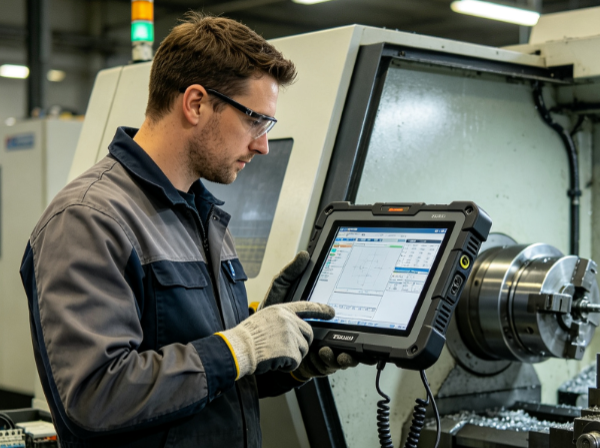
The decision to deploy mobile technology across a workforce often starts with a simple budgetary comparison. On the surface, a high-end consumer tablet appears to offer similar processing power and display quality at a fraction of the initial cost of an industrial-grade device. However, for enterprises operating in manufacturing, logistics, or field services, the “initial price” is a deceptive metric.
Reliability in a controlled office environment is vastly different from reliability in a cold-storage warehouse, a vibration-heavy construction site, or a humid manufacturing floor. This is why specialized industries consistently opt for a dedicated rugged tablet for business rather than attempting to “ruggedize” consumer hardware with aftermarket cases.

The Engineering Gap: Beyond the Protective Case
A common misconception is that a rugged tablet is simply a standard tablet in a thick shell. In reality, the internal engineering of industrial-grade hardware follows a fundamentally different logic.
Consumer tablets are designed for aesthetics and thinness, often utilizing adhesives to hold components in place. Under constant vibration or thermal cycling, these adhesives can fail. Conversely, rugged tablets, such as those found in the Industrial Tablet PC product lineup, are built with magnesium alloy internal frames and reinforced connectors to ensure mechanical integrity.
Critical Hardware Differences
- Thermal Management: Consumer tablets rely on passive cooling and often throttle performance or shut down entirely when exposed to direct sunlight or high ambient temperatures. Industrial tablets utilize advanced heat sinks to maintain peak CPU performance in extreme heat.
- Display Technology: A standard tablet’s screen is typically unreadable in direct sunlight (averaging 300-400 nits). Rugged tablets for business often feature high-brightness displays (up to 1,000 nits) and optical bonding technology to eliminate internal reflections.
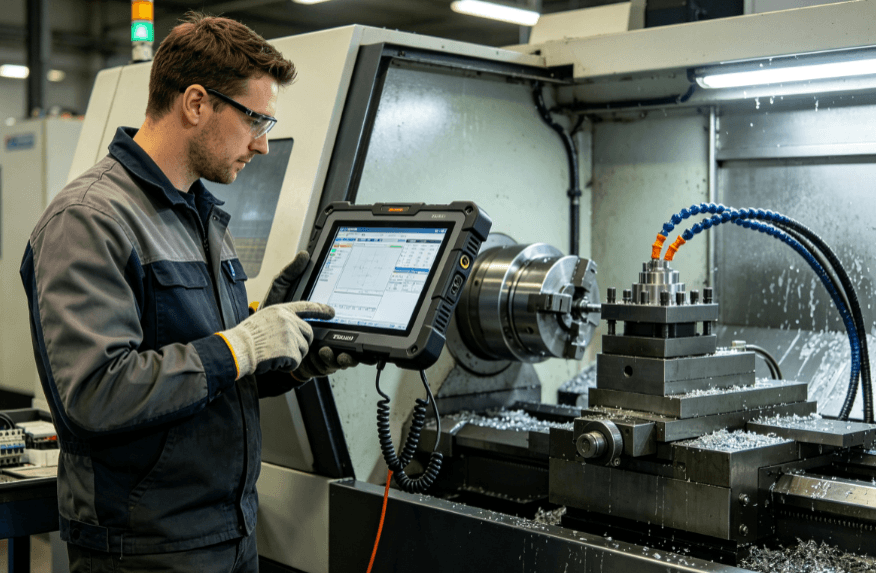
- I/O Versatility: While consumer devices are limited to USB-C, industrial workflows often require legacy support. Rugged units provide native ports for RJ45 (Ethernet), RS232 (Serial), and dedicated DB9 ports, allowing for direct interfacing with PLC systems and CNC machinery.
Total Cost of Ownership (TCO) vs. Initial Capital Expenditure
From a procurement perspective, the most compelling reason to choose rugged hardware is the Total Cost of Ownership (TCO). VDC Research has consistently shown that the failure rate of consumer devices in industrial environments can exceed 30% annually, whereas rugged devices typically see failure rates below 4%.
| Feature | Consumer Tablet + Case | Rugged Tablet for Business |
| Initial Cost | $400 – $800 | $1,200 – $2,500 |
| Annual Failure Rate | 18% – 35% | 2% – 5% |
| Battery Life | Fixed / Non-removable | Hot-swappable (24/7 ops) |
| Lifecycle Support | 12 – 18 Months | 3 – 5 Years |
| IP Rating | Usually IP67 (not drop-rated) | IP65/IP67 + MIL-STD-810H |
When a device fails in the field, the cost is not merely the price of a replacement. It includes the “soft costs” of technician downtime, lost data, emergency shipping, and the IT labor required to re-image a new device. Over a three-year deployment, a rugged tablet often costs 40% less than a consumer alternative when these factors are quantified.
Operational Continuity in Extreme Environments
In mission-critical sectors, “downtime” is the most expensive word in the vocabulary. Standard tablets are susceptible to “micro-cracks” in the motherboard caused by repeated minor drops or constant vibration in vehicle-mounted applications.
Impact Resistance and Ingress Protection
A rugged tablet for business is tested against the MIL-STD-810H standard, a military-grade protocol that involves multiple drops from 4 to 6 feet onto plywood over concrete. Furthermore, IP (Ingress Protection) ratings ensure that the device is not just “water-resistant” but can survive high-pressure water jets or total submersion, as well as fine particulate dust found in woodworking or chemical processing plants.
Gloved-Hand and Wet-Touch Capability
Standard capacitive screens often fail when used with work gloves or when moisture is present on the screen. Industrial tablets utilize specialized touch controllers that can be calibrated for “Glove Mode” or “Rain Mode,” ensuring that data entry remains accurate regardless of environmental conditions.
Lifecycle Management and Enterprise Security
One of the most overlooked risks of consumer hardware is the short product lifecycle. A specific consumer model may only be available for 12 months before it is discontinued. For an enterprise, this creates a “fragmented fleet” where IT departments must manage different drivers, accessories, and docking stations for every new batch of hardware.
Industrial manufacturers provide “long-life” availability. A rugged tablet for business purchased today will typically be available for purchase for the next 3 to 5 years. This stability allows for:
- Standardized Image Management: One OS image works across the entire fleet.
- Accessory Compatibility: Docks, vehicle mounts, and chargers remain compatible across hardware generations.
- Predictable Maintenance: Spare parts and repair services are guaranteed for long-term support.
Selecting the Right Rugged Tablet for Your Industry
Choosing the right device requires matching the hardware to the specific environmental stressors of your facility.
- For Warehousing & Logistics: Focus on integrated 1D/2D barcode scanners and long-range Wi-Fi 6 stability. An 8-inch form factor is often preferred for portability.
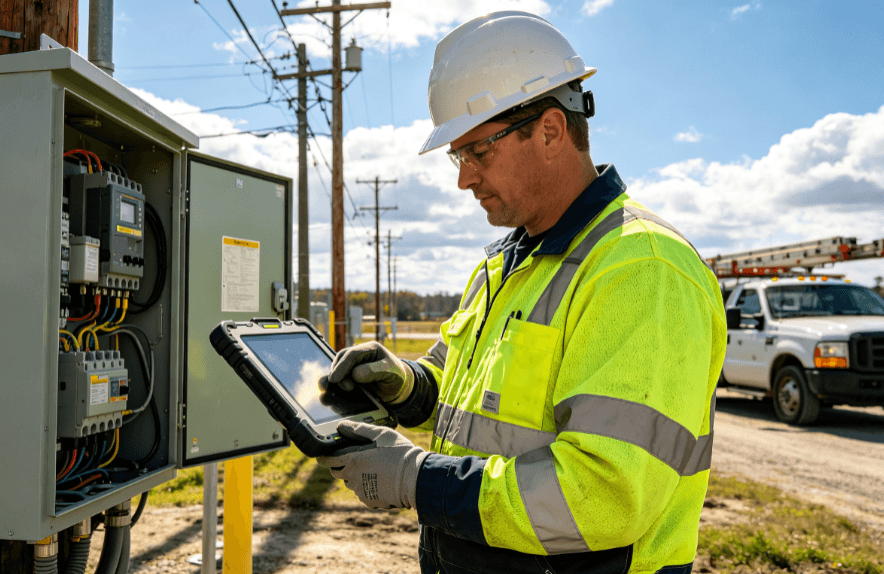
- For Field Service & Utilities: Priority should be given to 4G/5G LTE connectivity, GPS accuracy, and sunlight-readable screens.
- For Manufacturing Floors: Look for tablets with high IP ratings and VESA-mount compatibility for integration with stationary workstations.
When evaluating vendors, it is essential to look for those who offer specialized configurations. The Industrial Tablet PC product range provides options spanning both Windows and Android ecosystems, allowing businesses to maintain software compatibility with existing ERP or SCADA systems while benefiting from hardened chassis designs.
Conclusion: The Strategic Investment
While the consumer market prioritizes “thinner and lighter,” the industrial market prioritizes “resilient and reliable.” Choosing a rugged tablet for business is not merely an IT purchase; it is a risk-mitigation strategy. By investing in hardware designed for the rigors of the field, businesses ensure that their frontline workers have the tools necessary to maintain productivity, regardless of the environment.
FAQ
Q: Can’t I just use a high-quality rugged case on a standard tablet?
A: A case protects against some impact, but it does not address internal component failure due to vibration, thermal throttling, or port damage. Standard tablets also lack the sunlight-readable displays and hot-swappable batteries required for full-shift industrial use.
Q: What does MIL-STD-810H actually mean for my business?
A: It is a series of tests designed by the U.S. military to ensure equipment can withstand environmental stress. For businesses, this translates to a device that won’t fail when dropped from a forklift or exposed to the constant vibrations of a heavy truck.
Q: Is Android or Windows better for a rugged tablet for business?
A: This depends on your legacy software. Windows is preferred for complex ERP and CAD applications, while Android is increasingly popular for lightweight, task-specific apps in logistics and inventory management due to its lower power consumption and ease of UI customization.
Q: How do rugged tablets handle data security?
A: Unlike consumer devices, many industrial tablets include hardware-based security features like TPM 2.0 (Trusted Platform Module), integrated fingerprint scanners, and Smart Card (CAC) readers to ensure compliance with enterprise security protocols.
Reference Sources
- VDC Research Group: Total Cost of Ownership (TCO) Models for Mobile Devices in Enterprise.
- Department of Defense: MIL-STD-810H Test Method Standard for Environmental Engineering.
- International Electrotechnical Commission (IEC): IEC 60529 – Degrees of Protection Provided by Enclosures (IP Code).
- IEEE: Standards for Ruggedized Industrial Computing and Communications.