
How to Choose an Industrial Switch Supplier: A Technical Vetting Guide

Selecting an industrial switch supplier is not merely a procurement task; it is a critical engineering decision that dictates the long-term stability of an automated ecosystem. In harsh environments where downtime costs thousands of dollars per minute, the hardware’s reliability is inseparable from the manufacturer’s technical rigor.
For project managers and network engineers, the challenge lies in distinguishing between “commercial-grade components in a metal box” and true industrial-grade networking solutions. This guide outlines the essential technical benchmarks, manufacturing standards, and commercial evaluation criteria necessary to vet a high-tier industrial switch manufacturer.
Technical Benchmarks: Beyond the Data Sheet
A reputable industrial switch supplier must demonstrate that their hardware can survive the “Three Extremes”: temperature, electrical interference, and physical stress.
Thermal Management and Fanless Design
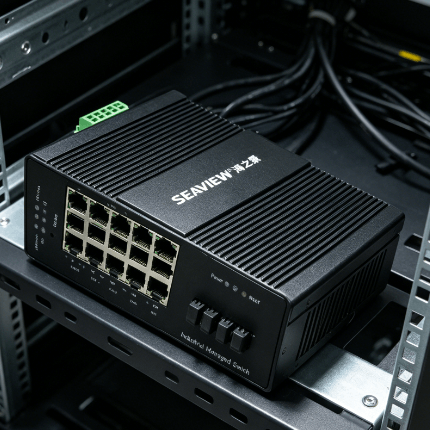
True industrial switches, such as those found in Seaview Industry’s professional range, utilize fanless designs. Moving parts like fans are the first point of failure in dusty or vibrating environments. Evaluate suppliers based on their heat dissipation engineering. High-quality manufacturers use high-thermal conductivity aluminum alloy shells to maintain stable operations in temperatures ranging from -40°C to 75°C (-40°F to 167°F).
Redundancy Protocols
In industrial networking, “recovery time” is a vital metric. Ask potential suppliers about their support for redundancy protocols. While standard STP/RSTP is common, a specialized industrial switch manufacturer will offer ERPS (Ethernet Ring Protection Switching) or proprietary ring technologies that ensure network recovery in less than 20ms or 50ms.
Industrial-Grade Component Sourcing
The internal components determine the Mean Time Between Failures (MTBF). Top-tier suppliers provide detailed MTBF reports, often exceeding 300,000 hours. If a supplier cannot provide data on their capacitor grades or chipset origins, they are likely rebadging commercial hardware.
Manufacturing Rigor and Compliance Standards
The “Industrial” label is defined by certifications, not marketing. When vetting a manufacturer, request documentation for the following global standards:
| Standard | What it Validates | Why it Matters |
| IEC 61000-4 | Electromagnetic Compatibility (EMC) | Ensures the switch won’t reboot during high-voltage surges or ESD. |
| IEC 60068-2 | Shock and Vibration Resistance | Critical for switches mounted on moving machinery or near heavy turbines. |
| IP30 / IP40 / IP67 | Ingress Protection | Defines the level of protection against dust, tools, and moisture. |
| CE / FCC / RoHS | Regional Compliance | Essential for legal importation and environmental safety standards. |
A supplier’s ability to provide these test reports—not just a logo on a website—is a primary trust signal. Professional manufacturers maintain in-house testing labs for burn-in testing, ensuring every unit has been stressed under load before shipping.
Evaluating Application-Specific Capability
Not all industrial switches are created equal. Your supplier should offer a portfolio that matches your specific architecture.
Managed vs. Unmanaged: For simple edge connectivity, unmanaged switches suffice. However, for critical infrastructure, look for manufacturers offering Layer 2+ or Layer 3 managed switches that support VLAN tagging, QoS for industrial protocols (like Profinet or EtherNet/IP), and IGMP snooping.
PoE (Power over Ethernet) Capacity: If your project involves IP surveillance or wireless APs, verify the supplier’s PoE budget. Industrial PoE switches must maintain stable power delivery even as temperatures fluctuate.
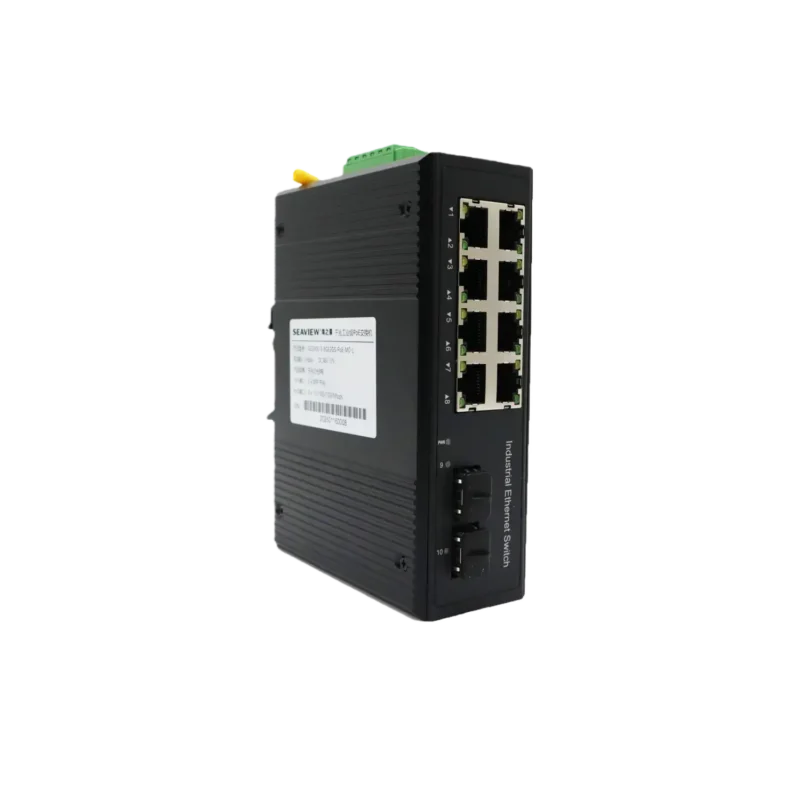
Mounting and Form Factor: In tight control cabinets, DIN-rail mounting is the standard. Suppliers like Seaview Industry offer compact DIN-rail designs that maximize cabinet space without compromising port density or thermal efficiency.
Commercial Logistics: RFQ, MOQ, and Lead Times
Once technical requirements are met, the transactional capabilities of the industrial switch supplier determine project feasibility.
Customization and OEM/ODM Support
Many industrial projects require specific port configurations (e.g., a mix of SFP fiber ports and RJ45 copper ports) or private labeling. A manufacturer with strong R&D can provide “Small Batch Customization.” Inquire if they can modify firmware or hardware interfaces to suit specialized protocols or branding requirements.
Lead Time Stability
The global semiconductor supply chain remains volatile. A reliable supplier should offer transparent lead times. Ask:
Do you maintain a buffer stock of core chipsets?
What is the typical lead time for an order of 500 units vs. 5,000 units?
Do you provide expedited shipping for critical maintenance repairs?
Minimum Order Quantity (MOQ)
For OEM projects, MOQ is a major hurdle. Leading industrial manufacturers often provide a two-tier system: low MOQ for standard catalog items to facilitate prototyping, and higher MOQs for customized hardware or private labeling.
Post-Sales Support and Technical Documentation
In the industrial sector, the relationship begins after the sale. A “box-mover” supplier will disappear once the invoice is paid. A strategic partner provides:
Detailed Integration Guides: Documentation on how to integrate the switch with PLC systems (Siemens, Rockwell, etc.).
Firmware Updates: Regular security patches to protect against industrial cyber threats.
Direct Engineering Support: Access to FAEs (Field Application Engineers) who understand network topology, not just sales reps.
The Seaview Industry Advantage
For engineers seeking a balance between ruggedized performance and procurement flexibility, Seaview Industry serves as a specialized manufacturer in the industrial networking space. Their product line focuses on high-reliability DIN-rail switches designed for harsh environments, offering features like:
Wide-range DC power inputs (12-48V or 48-57V for PoE).
Fiber optic uplink options for long-distance interference-free transmission.
Industrial-grade EMC protection levels.
Agile manufacturing capabilities that support both small-scale specialized projects and large-scale industrial rollouts.
By focusing on these technical and commercial pillars, procurement teams can move beyond “price-based” buying and toward “value-based” partnerships that protect the integrity of the industrial network.
FAQ: Choosing an Industrial Switch Manufacturer
Q1: What is the typical MOQ for custom industrial switches?
Standard catalog items often have no MOQ or a low requirement (e.g., 5-10 units). For custom PCB layouts or specific housing designs, MOQs typically start at 100-500 units depending on the complexity of the engineering changes.
Q2: How do I verify a supplier’s MTBF claims?
Request the Bellcore or MIL-HDBK-217F calculation report. Reliable manufacturers use these standardized methods to predict hardware longevity based on component stress and ambient temperature.
Q3: Can commercial switches be used in industrial settings to save costs?
It is not recommended. Commercial switches lack the surge protection, vibration resistance, and wide temperature tolerance required for factory floors. The cost of one hour of network downtime usually exceeds the “savings” from buying a commercial-grade switch.
Q4: Do industrial switch suppliers provide samples for testing?
Yes, most reputable manufacturers offer a “paid sample” program where engineers can purchase 1-2 units for bench testing and interoperability verification before committing to a full-scale RFQ.
Q5: What is the importance of a fanless design in an industrial switch?
Fans are mechanical parts prone to failure due to dust ingestion and bearing wear. A fanless design uses passive cooling, which significantly increases the lifespan of the device and allows for sealed enclosures (higher IP ratings) that protect against contaminants.
Reference Sources
IEEE 802.3 Standard: The foundational standard for Ethernet connectivity in industrial environments.
IEC 61850: Technical standard for communication networks and systems in substations.
Industrial Ethernet University: A resource for understanding redundancy protocols and industrial network design.
Cisco Industrial Networking Certification (Reference for industry best practices).